
The Father Friend Model©

Based upon years of child development research and the timeless wisdom of Scripture, this model helps you understand key roles to fulfill in each phase of your child's development.

Before reading the model, it's helpful to first understand What Is A Father-Friend?
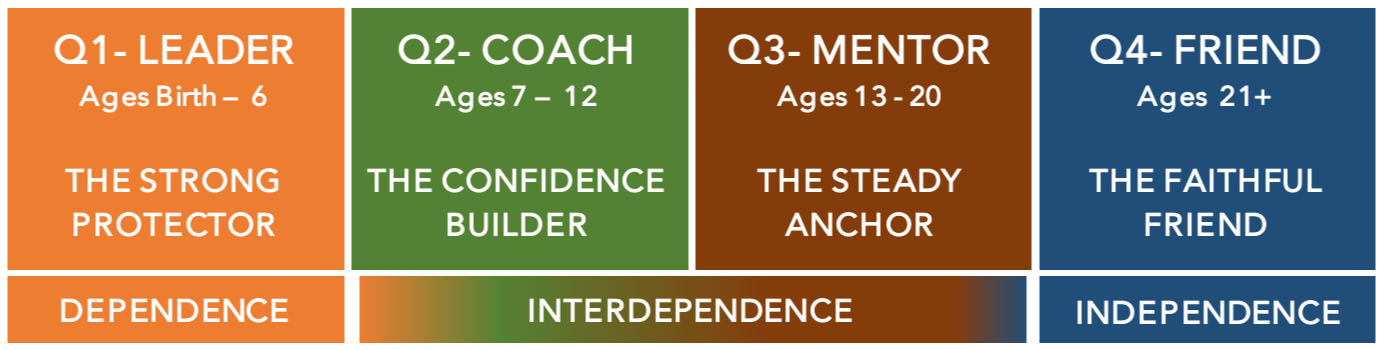
About the model:


This Model Spans Roughly 21 Years of Fatherhood

Don't let that intimidate you. It sounds like a long journey—but it moves fast. 

In fact, many child development experts suggest you only have about a 10-year window to make your most lasting impact.

So, dad, lean in now. Be present. These years matter more than you think.

The Model Includes Four Phases of Fathering

I've represented them as quadrants—each aligned to a stage of your child's development and your corresponding role as father. The key? Progress in order.

You can't father a 5-year-old like a teenager or a teenager like a 5-year-old. Try to reason with a preschooler instead of providing leadership, and you'll create chaos. Try to control a 16-year-old like a 6-year-old, and you'll face rebellion. Each child needs you to show up based on where they are developmentally, not where it's comfortable for you.

Think of it like building a house: foundation first, then wiring, then decorating. It’s the same with fatherhood—doing the right work at the right time.

Each phase spans roughly 5-6 years and has a starting point and end goal. The father's job is to guide a child from the developmental baseline at the beginning of the phase to the growth milestone at its peak.

The Model Focuses on the Development of Fathers

Most parenting models focus primarily on the child—understand how kids develop and you'll be fine. This one is different.

It's not enough to understand how children develop. What's needed is a framework that shows dads how to develop in response to their child's growth.

The Father Friend Model is a call to grow, to adapt, and to change your approach as your kids advance in age.

The Logic Behind the Age Groupings

The ages within each quadrant are not grouped because an 8-month-old is developmentally identical to a 6-year-old, or because a 13-year-old faces the same challenges as a 19-year-old. Clearly, they don't. But what unites these ranges is not sameness—it's shared need.

Children in each phase need the same primary role from their father. A 2-year-old and a 6-year-old are very different—but both need you to be their Strong Protector. A 13-year-old and a 19-year-old face different challenges—but both need you to be their Steady Anchor.

Developmental psychologists might break childhood into as many as four-to-six distinct stages before adulthood, focusing on cognitive, emotional, and social growth. This model doesn't disregard those insights—but its primary aim is different. As previously stated, this approach centers on the unique role a dad must play in each phase of a child's development—and on the father's personal growth required to meet those needs with strength, wisdom, and love.

The Model Is a Framework, Not a Formula

This isn't rigid or a checklist. It's a compass, not an instruction manual. Let the model guide you, not rule you.

No model can hand you pre-packaged answers for every moment you'll face as a dad. But what this one offers is a way to think—a lens through which to discern, decide, and lead with purpose. You'll learn to respond with balance, wisdom, and grace as situations arise. Not perfectly. But intentionally.

Be wise as you move through the phases:

  • Look for your child's readiness more than the calendar.
  • Adjust your approach by area, not just age. For example, a 14-year-old might be ready for Q3 identity mentoring but still need Q2-style coaching around managing their time. There will be natural overlap—you might still use strategies from a previous quadrant for a while or begin to dip into the next one as your child matures.
  • The transition isn't abrupt—it's a gradual shift from one primary focus to the next beginning around the ages designated in each quadrant.

Pushing kids to grow up too fast robs them of childhood. Treating teens and young adults like children robs them of needed growth. Don't rush them forward, and don't hold them back.

Let your child be a child (Q1). Let your kid be a kid (Q2). Let your teen be a teen (Q3). Let your young adult be a young adult (Q4). Treat them as such in each phase. Trust the process.

The Model Is About Your Growth—But It Fuels Theirs

Your goal is to become a trusted Father Friend by the time your kids reach young adulthood.

But the overarching goal for your child is something psychologists call self-efficacy—the deep belief that "I am enough."

The objective is that your child can meet challenges, solve problems, and build a life with confidence and internal security. Your fathering is the soil that cultivates that kind of strength.

Here's the process toward self-efficacy: The model moves them from dependence in Q1, toward interdependence in Q2 and Q3, to independence in Q4.

Every Trait Matters in Every Phase—But Each Has Its Time to Shine

The attitudes and actions outlined in each phase are a focus for dads particularly relevant to children in that developmental stage.

That doesn't mean those actions are unimportant in other phases and should be excluded. It means they are especially vital in their assigned phase and should not be neglected in that quadrant.

Yes, you'll lead, coach, mentor, and be a faithful friend at every phase—but each role is especially important during its designated one.

This is the wisdom of intentional fatherhood: doing the right work at the right time.

Be faithful to the actions and attitudes of the father-friend model, and allow results to play out. Focus primarily on you, not outcomes. Be and do right, and right things will come. Remember, the last thing to grow on a tree is the fruit.


UNDERSTANDING QUADRANTS

Quadrant 1 - LEADER
Fathers with children in their youngest years (ages 0 – 6). The primary focus in Quadrant 1 is for dad to establish leadership of his kids, i.e. the role of a LEADER. This involves key behaviors of directing, setting boundaries, establishing routines, teaching, building trust through consistency, and discipline.

Quadrant 2- COACH
Fathers with children in elementary and preteen years (ages 7-12). The primary focus in Quadrant 2 is for dad to equip his kids, i.e. the role of a COACH. This is the phase where children develop confidence and competence. This involves key behaviors of coaching, teaching life skills, setting goals, giving responsibility and empowerment, affirmation, training, building trust through your consistent presence and engagement.

Quadrant 3 - MENTOR
Fathers with children in their teen and adolescent years (ages 13-21). The primary focus in Quadrant 3 is for dad to encourage his kids, i.e. taking the role of a MENTOR. This is the phase where children desire independence and normal emotional distancing from parents occurs. Peers not parents become most important to your child. This can be a challenging phase as dads learn to tell and direct less, and guide more. However, this does not mean withdrawing from the life of your child. Handled correctly, this can be one of the most rewarding times as a father when you see your children move into young adulthood— your hard work is paying off! This quadrant involves key behaviors of listening, praising, affirming, setting boundaries and discipline (suitable for teens), giving responsibility and empowerment, training them to earn trust, providing opportunities that prepare for adult life, building your trust with them through a consistent, non-anxious presence and "being there".

Quadrant 4 - FRIEND
Fathers with children in young adult to adult years (ages 21+). The primary focus in Quadrant 4 is for dad to encourage his children, i.e. fulfilling the role of a Father-Friend. This is the phase where you have done your work, and the goal now is to be a supporter of your child. This quadrant involves key behaviors of listening, affirming, supporting, empowering, trusting and refraining from telling and directing. When called upon, dad can be there for advice and comfort.